Do I Understand the Average American? Or, Ways To Be a Useful Member of Society Without Founding a Tech Company or Working in AI
A question that I've been mulling over for the past couple of months is this:
"You like to feel helpful. Okay, so why are you in SF?"
The unspoken part of this question, I think, is this: why are you in the SF Bay Area, where the people to whom you extend your generosity do not need it whatsoever?
Who needs saving in the SF Bay Area?
One thing you should know about me is that I like to feel helpful.
And gosh, this is a rather unfortunate fact to declare about myself when I live in the Bay Area. The Bay Area is full of techies, I too am a techie, and when I look at the list of people I most recently talked to, if they're not a family member or an old friend who I made long before my entrance into techiedom, they're a techie.
Tell me, in the Bay Area, do any of the techies need my saving?
"Not I," said the techies.
No! See, it's so expensive to live here, that by virtue of being able to exist here, you probably have the kind of material comforts that mean you don't need my saving.
Okay, okay, you say.
What about the kids? you offer. Kids are pure and innocent little creatures, there are many things that nobody has shown them yet, and many ways in which you, Jess, the patient adult who bothers to be there for them, might make a whole difference in this formidable time of their lives.
To this, I say: in the Bay Area, do the children of techies need my saving?
"Not I," said the children of techies.
No! Trust me, I have tried, and I can tell you without ambiguity, the children of techies don't need my saving.
Every single thing I could possibly think of giving them, they already have a better version of.
At least when it comes to stuff like tutors and summer programs, lol, the kids definitely have no shortage of that.
Meanwhile, having a real pal might be a different story. (and whether I can be that "real pal" to all of these kids is also a different story)
"Not I," said... well, everyone.
Perhaps the piece that best captures my current state of mind is After Work, We'll Have Each Other, which muses about what people will do when the machines take the jobs, and which spends a good while talking about rich women in 1984 Cleveland and other sorts of aristocrats, and what on earth do they get on with when they don't need to work?
These women of 1984 Cleveland do not work. Instead, they volunteer, which for them means sitting on the boards of the opera and the symphony and raising money from the other rich people that they already know.
This volunteering is socially mandatory, and these women are quite good at it, and, in spite of being good at it, the author observes:
"...while most of the women acknowledge a sense of noblesse oblige, none of them care much if their volunteer work achieves tangible results for the communities they serve."
Upon being interviewed, these women confess that it's the illusion of being useful that's satisfying, that they're "... not sure what [they've] done has really accomplished anything, a lot of it is busy work."
It isn't that nothing happens. Things do happen, you do see good numbers go up and bad numbers go down, sometimes you get thanked by the people who want those numbers, and you feel like you've done a good job as a result of these numbers moving in the direction that you desire them to move.
And, in spite of my day-to-day being productive in the techie's sense of productivity, I do sometimes feel like my view of the world is not THAT much wider than those 1984 Cleveland ladies, that I perhaps have a little more grease under my nails (those GPUs, do, after all, need babysitting), but with a worldview that could be widened nonetheless.
My "average American" thought experiment
Now, to answer this question of "how can I widen my worldview," I think we can begin with a rather non-sequitur question:
"Do you think you represent the average American?"
This question being, do I see myself as someone who can speak on behalf of the average American?
If I run for the House or Senate tomorrow, can I stand at a podium and say with a straight face, "Hello American! I know what you need, and I'm the person to get it for you"?
To this question, my gut answer is "No!"
When I examine my visceral "no!" reaction, the best explanation I can gesture at is this: I'm a techie, and techies are not terribly relatable to the average American. When I say "I'm a techie," I feel like I emanate an aura that's neutral at best, and evil/insular at worst.
As individuals, we techies also emanate an aura of curiosity, creativity, and earnest generosity, but, ah, when you lump us together as "the tech sector," to the pundits and policy wonks we mostly emanate that aura of evil/insularity. :P
Why this "average American" question?
The reason I put out this "average American" thought experiment is that when I say I want to feel helpful, I mean to say that I want to feel like a contributing member of society, someone who is useful to her neighbors.
And I do get this feeling, sort of. I get this feeling from my job, and I get this feeling from being a fairly well-plugged-in member of the tech world.
If you ask me, "Do you think you represent the average techie?", my answer would be a resounding yes.
Yes please, be my guest, you can summon me to speak as a Representative of Techies tomorrow, and I can stand at a podium and say with a straight face, "Hello techie! I know what you need, and I'm the person to get it for you."
When a friend comes to me with a techie problem, whether that's how to learn a thing or make a widget or who they should talk to in some part of the security/AI/software industry, I'm confident that I can help them.
This bothers me, that I can be measurably helpful to my fellow techie and still feel like I'm living in a bubble, helping people who're going to be alright anyway.
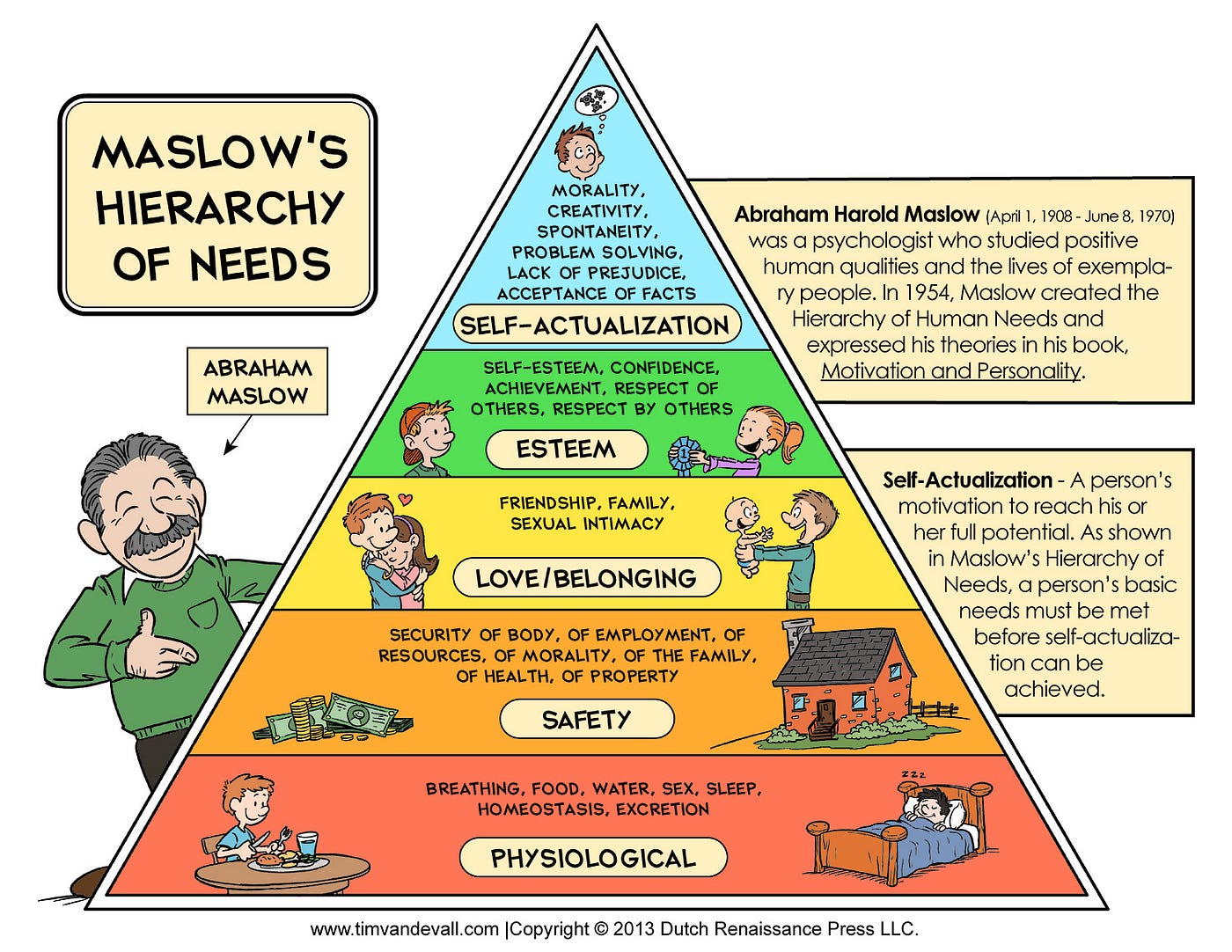
Maybe the reason I feel like my fellow techies are going to be alright anyway is because I know that their problems and my problems are on the tippy-top of Maslow's Hierarchy of Needs ("am i living up to my highest potential?" or "who is more cracked, me or my buddy who just pulled off this cool feat?"), that whatever happens to us can't be that bad regardless of how we solve each other's problems.
When I'm at my most tired, I feel like half the problems I witness in the techie world are along the lines of one group of techie apes beating their chests and flinging poo at a different group of techie apes to prove who's the alpha techie ape.
What problems exist outside of my bubble and am I of any use there? What better way to do that than to zoom out, and look at the country as a whole, and ask myself why I don't yet feel like I represent the average American, and what I would need to do to get there?
Even if I end up as some Ira-Glass-esque story of "well-meaning techie invades rural town and finds out that the locals don't need saving anyway," I still think that's a more honorable way to fail than "comfortable techie remains comfortable."
What remains painfully bad about the world?
It's not hard to see why us techies, especially our most extreme breeds, might be perceived as a tad bit out of touch by the rest of the world.
The value of AI is indisputable to us techies and our techie problems. Look, AI can write software, look, AI can find security vulnerabilities, and it's tempting to extrapolate this to everything outside of tech, to say that AI will bring about human emancipation/extinction/salvation/damnation.
Yet, in spite of all the talk about how nonstop onslaught of artificial intelligence shall bring about human emancipation/extinction/salvation/damnation, the world outside of tech has remained largely untouched.
So I wonder, what remains painfully bad despite all this new AI capability and why? The problems that remain painfully bad, I think, didn't come out of a shortage of intelligence to begin with, so a flood of intelligence hasn't fixed them all that much.
When I think and categorize the problems by their bottlenecks, they tend to be blocked by things such as...
Anything that requires approval
You can use AI to help you write your application, but alas, as beautiful and polished as you can make your application, it faces the same foe as everybody else's: a human on the other end who has the power to say no.
As a little brainstorming exercise, when I think about how often I, or someone I know, is waiting for a human who has the power to say no, it's usually along the lines of
- applying for housing (an apartment lease)
- applying for monies (loans, grants, scholarships)
- applying for membership of an institution (a school, a company, an org, etc.)
- applying for membership of a country (or, in more normal-people terms, applying for a visa)
- applying for a particular medical procedure
- any legal problem
This list is just for starters, but it can inspire other questions, like who is this human who has the power to say no, and what might make it hard for them to say yes?
Those questions might expose some pain points and point us towards ways to be a useful member of society without being a tech founder or working in AI.
Anything that requires coordination
Any time we're dealing with a pool of resources (money, people, time), we end up discussing how to allocate this pool across various projects.
We have many, many theories about how to do allocation, yes, but the hard part is usually getting everyone to agree on the allocation. Housing and public infra are a pretty classic examples; we know how to build these things, but the decision to build them is often blocked by the need to get many, many people with competing interests to agree.
This is more of my personal bucket list, but to start with, I have:
- Read more about housing / transit / public infra projects
- Survey a neighborhood entirely by foot or bike and take note of what's well maintained vs neglected or under construction
- SF Crosstown Trail
- TODO other trails that take us through formidable neighborhoods
- File a 311 report for some piece of public infrastructure and keep track of how long it takes to get fixed
- Go to a transit board or city council meeting to see how people discuss trade-offs for allocations
These exercises might expose some pain points and point us towards ways to be a useful member of society without being a tech founder or working in AI.
Anything that requires physical presence
Anything that requires physical presence, that requires hands and a body.
The list of professions that fit this description is pretty long: nurses, home health aides, daycare workers, teachers, EMTs, firefighters, police, plumbers, electricians, farmworkers, line cooks, cleaners, to name a few!
Though, from Asterisk Magazine's So You Think You Could Be An Electrician?, it seems like the trades have gotten less physical and more mental over time, so AI could reduce some cognitive load:
"...we might not need robotics to advance all the way to human-level handling of current tools before we see significant reductions in the need for human labor.
As dexterity demands have decreased, work in the trades has also gotten more cognitively demanding. It’s likely that AI could reverse this."
Once again, here's another list of bucket-list items:
- Volunteer at a nursing home or a hospital.
- Tutor kids or coach them in some sort of activity at an after-school program, specifically kids who don't get much one-on-one attention
- Do a ride-along with 911 first responders (fire department, EMS crew, or police department)
- Shadow a plumber or electrician for a day, or learn to fix some basic stuff in your own home
- Pick up shifts in service work (restaurant, retail, etc.) and see what an average day is like
These exercises might expose some pain points and point us towards ways to be a useful member of society without being a tech founder or working in AI.
Books for further reading
It's somewhat ironic that I talk about the virtues of getting out of the house, and then I prescribe a bunch of books so that you can live vicariously through other people who managed to get out of the house.
But I enjoyed these books and I do think they can inspire you to pay attention differently in your ordinary life, when you do get out of the house.
Elizabeth Gilbert's The Last American Man
If you'd like to get a feel for whether this book might be your thing, here's the GQ article of the same name, a shorter piece that she wrote before she embarked on the endeavor of writing a whole book about this Eustace Conway man.
Elizabeth Gilbert's comedic timing is immaculate. She is one of those writers who can write about literally anything and I manage to read her writing without skipping a single word (no hyperbole!) and stay entertained.
My very first introduction to her, actually, was through an SAT reading passage, and I usually skim my way through those passages, but for her, I found myself going, "Well, this passage about some girl named Ruth and a bunch of lobstermen off of the coast of Maine is hilarious."
I read every single word (rare of an SAT passage!), then looked up the author as soon as I was done with the test, because any writer who can get me, Jess, emotionally invested in some randoms off of the coast of Maine has real talent.
Michael Lewis's Who is Government?
The thing that hooked me about this book was Michael Lewis's claim that not even the people elected to run the government really know what federal employees do all day. Whenever a new president takes office, they send a squad of people to DFS their way through the agencies to figure out what each department is supposed to do and who's actually doing it.
Due to this absurdity of "not even the supreme leader knows what his reports do all day," Lewis turns the question back on the reader,
"We never ask: Why am I spending another minute of my life reading about and yapping about Donald Trump when I know nothing about the 2 million or so federal employees and their possibly lifesaving work that the president is intent on eliminating?"
What really made me want to read it, though, was his explanation of why the government struggles to hold on to its best people, and how you'd think that "creating a culture of recognition" by handing out awards would be easy, but it turns out almost no one wants to step forward to be recognized.
John Steinbeck's Travels with Charley
John Steinbeck is a little like Elizabeth Gilbert in his ability to hook me on even the most ordinary-sounding topics.
"New York is no more American than Paris is France or London is England.
Thus I discovered that I did not know my own country. I, an American writer, writing about America, was working from memory."
Usually I'm a little bored by travel writing, but he manages to keep me interested with his voice, and makes me feel like I'm a little "in" on his secret due to his detailed descriptions of traveling incognito as an otherwise recognizable famous author and all the special tips he gives, which I catch myself mentally bookmarking ("good to know! i will do this when i get a camper truck, mr. steinbeck!") as if I'd need them someday, despite having no plans to get a camper truck in the near future or possibly ever.
I think it's really the way he can say things that everyone already knows in a way that's not at all obvious, like when you see something on your daily walk that's always been there and you just didn't notice it before.
Books for further reading, but for me specifically
Meanwhile these are books that I haven't finished yet and will hopefully fold into the above when I do finish:
- Ezra Klein's Abundance
And books on my to-read list:
- Barbara Ehrenreich's Nickel and Dimed
- mostly... the scathing one-star reviews on Goodreads tell me that that good intentions don't stop an author from sounding out-of-touch, so I'm reading it partly for the content and partly as a guide to avoid sounding like that...
Anyway, after a hard day's work of raising shareholder value, let us get off of our screens and go be useful members of society!