Reversing My Childhood Games 1/N: How Does Fashion Dogz Score An Outfit? [Nintendo 2DS]
Last year, in the spare time I had before starting work, May-July 2025, I became curious about how well AI agents could reverse engineer games.
Jess's Childhood Gaming Canon
To give you a better idea of my childhood gaming canon, I come from a no-video-games kind of family, so the only time I got to play games, "got to" in the sense of my parents being aware that I was playing, was on a Nintendo 2DS during road trips, when we were stuck in the car with nothing else to do.
Outside of that, the games I played, in the sense of my parents not being aware that I was playing, were browser games and free downloadable games, which, ah, ranged from wholesome dress-up games to all sorts of bizarre games with jokes that I should not have understood.
For future installments of this series, I also intend to write about
- The Supercard DSTWO, a card my dad acquired from the DS homebrew scene
- this was the reason that my road trip game library was suspiciously larger than the number of game cartridges we owned
- Some other games from my childhood gaming canon, primarily
- more Nintendo 2DS games
- the Adobe Flash games cinematic universe
- the RPG Maker horror games cinematic universe
- ...the scratch.mit.edu cinematic universe?
One of the games I had some unfinished business with was Fashion Dogz.
Fashion Dogz was a solid game, aside from the fact that I could never for the life of me figure out the fashion combinations. I advanced to the part of the game that required me to have nonzero fashion sense, and I was blocked by my inability to find a single combination that was a matching set.
It was 2010, and nobody writes strategy guides for games aimed at seven-year-old girls, so I could not find any guides online for this niche Nintendo 2DS title. The shame of this defeat that was inflicted upon my seven-year-old brain would follow me for the rest of my adult life.
Introducing my 2025 setup
In early 2025, I got pretty into doing stuff around MCP (Model Context Protocol), and keep in mind this was the time when MCP was the hoopla. We hadn't perfected coding agent harnesses yet. Agents weren't very independent, and they were nowhere near the superintelligent beings they are today, so we still thought they needed bells and whistles to be any good, and MCP was one of those bells and whistles.
I saw that Binja (Binary Ninja) was a great fit for MCP, as it's a reverse engineering tool with a scriptable API that lets you write your own extensions. Although I personally use IDA Pro, I found that IDA Pro was not nearly as pleasant to script. So I wrote a Binja MCP server that exposed Binja's features as tools, so an LLM could make tool calls to read and inspect the binary.
It took me half a day to recover the fashion combinations, using a two-window workflow. In the foreground, I reverse engineered the game myself in IDA Pro. On the side, I had a chat window open with Claude Desktop, connected to my Binja MCP server. I never actually opened Binja; it ran in the background purely as Claude's way of reading the binary. So Claude and I were looking at the same game through two different tools, me through IDA, Claude through Binja.
My 2025 setup was not autonomous
You can think of me as having done most of the reverse engineering, while Claude was my "colleague" I turned to with questions like "where is this table referenced?"
You can think of the tool I used, Claude Desktop, as a passive chatbot that waits for your question and responds with an answer. Meanwhile, an autonomous harness is more like a chatbot that runs in a loop: it takes a goal, decides on a next step, takes it, looks at the result, and repeats until the goal is done.
I didn't start using autonomous harnesses until much later, when I installed Claude Code around December 2025.
How do today's agents do?
I'm curious now, how do the newer, more autonomous harnesses handle the same task?
So today I asked Codex, running GPT-6.1-Sol, to recover the outfits. I put it in /goal mode with a single goal: find all the fashion combinations. It completed the /goal in 8 minutes.
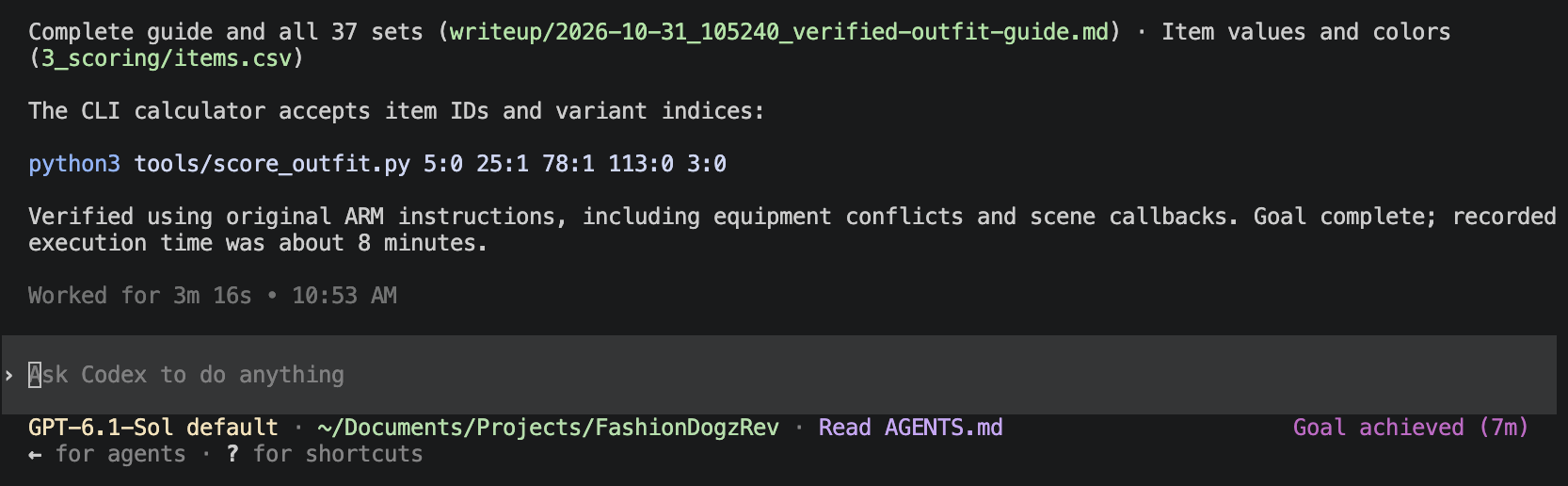
Wow! Crazy! GPT basically did this bare-handed. I gave it only the .nds ROM. It didn't touch MCP or any pre-existing tool. It just wrote its own Python scripts to work on the raw bytes.
Why does this surprise me
I did not think agents were capable of reverse engineering a binary without help. I assumed they needed a full disassembler + decompiler + debugger suite like IDA Pro/Ghidra/Binja, or at least MCP tools that connected them to one, because the last time I asked an agent to work on raw bytes, it couldn’t.
Also, 8 minutes is insane...
The answer for all you Fashion Dogz players
Your fashion score is computed as...
fashion score = min(33, set bonus + item values + color bonus)
To elaborate on each ingredient,
- First, the game computes a "set bonus" by matching your outfit against a list of 37 sets and taking the first match
- you may have zero matches if you are terribly unfashionable
- Next, the game computes your item values, aka the expensiveness of your outfit, where each worn item contributes 1–3 points.
- Finally, the game computes a color bonus.
- Four matching items gives you 10 points, five gives 15 points, six gives 20 points.
When you exceed 33 points, the game cuts you off at 33 because you can't be too fashionable I guess. :P The maximum-score outfit is set #35 {Retro Glasses, Afro Hair, Frog Overalls, Leg Warmers} plus a Dotted Collar, all in pink. The collar isn't part of the set, but as a fifth pink item it gives you five bonus points in color, giving 38 raw points.
Here are all fashion items in the game with their item points and color variants.
...and here are all 37 sets that would give you points.
| Priority | Bonus | Required items |
|---|---|---|
| 1 | 10 | Baseball Cap, Baseball Uniform, Baseball Pants, Studs |
| 2 | 10 | Soccer Wear, Soccer Pants, Studs |
| 3 | 12 | Bowtie, Silk Hat, Tuxedo, Formal Pants, Leather Shoes |
| 4 | 12 | Pom-Pom Muffler, Santa Cap, Santa Costume, Santa Pants, Casual Boots |
| 5 | 7 | Angel's Halo, Angel Wings, Socks |
| 6 | 13 | Checked Scarf, Cowboy Hat, Western Pants, Long Boots |
| 7 | 5 | Sailor Suit, Loose Socks |
| 8 | 5 | Chinese Hat, Dragon Jumper, Big Shoes |
| 9 | 10 | Swimming Goggles, Swimming Cap, Swimming Trunks, Flippers |
| 10 | 8 | Jersey Shirt, Jersey Pants, Slippers |
| 11 | 5 | Kimono, Japanese Boots |
| 12 | 12 | Silver Necklace, Tiara, Princess Dress, Long Boots |
| 13 | 14 | Sunglasses, Straw Hat, Aloha Shirt, Jeans, Beach Sandals |
| 14 | 9 | Headband, Japanese Jacket, Japanese Clogs |
| 15 | 10 | Checked Muffler, Glasses, Coat w/ Fur |
| 16 | 7 | Bear Parker, Bear Slippers |
| 17 | 14 | Checked Scarf, Straw Hat, Overalls, Boots |
| 18 | 13 | Fashionable Cap, Training Jumper, Jeans, Sneakers |
| 19 | 13 | Silver Necklace, Turtle Neck, Long Boots |
| 20 | 13 | Apron, Night Cap, Baby Clothes, Socks |
| 21 | 10 | Gerbera Corsage, Fairy Skirt, Heels |
| 22 | 10 | Tartan Check Trainer, Pleated Skirt, High Cut Shoes |
| 23 | 12 | Sun Visor, Latin Bordered Shirt, Formal Pants, Leather Shoes |
| 24 | 8 | Topknot, Japanese Jacket, Japanese Boots |
| 25 | 15 | Retro Glasses, Beret, Comic Artist, Skirts, Leg Warmers |
| 26 | 9 | Knit Cap, Turtle Neck, Socks |
| 27 | 13 | Sunflower Corsage, Tank Top, Frilly Pants, Casual Boots |
| 28 | 5 | Rain Coat, Boots |
| 29 | 6 | Sun Visor, Frilly Bikini, Frilly Pants, Beach Sandals |
| 30 | 6 | Sunglasses, Opaque Pants, Leather Shoes |
| 31 | 6 | Checked Scarf, Opaque Skirt, Casual Boots |
| 32 | 14 | Silver Necklace, Checked Cap, Tartan Check Trainer, Pleated Skirt, School Shoes |
| 33 | 14 | Beret, Cape, Long Boots |
| 34 | 10 | Fashionable Cap, Parker, Jeans, Sneakers |
| 35 | 13 | Retro Glasses, Afro Hair, Frog Overalls, Leg Warmers |
| 36 | 11 | Checked Scarf, Helmet, Training Jumper, Leather Mini-Skirt, High Cut Shoes |
| 37 | 5 | Japanese Apron, Topknot, Japanese Clogs |
Happy Halloween, and may your dog's costume score a perfect 33!