Jess’s Quest to Become an Orator: Or, How to Hold Down the Fort When You’re Talking to a Ben-Shapiro-Wannabe on a Podcast
I, Jess Ruan, am not a Podcast Guy. I am a Writing Guy. You can call me an Essays Guy, a Substack Guy even, if I had a Substack, but one thing that I insist I am not, is a Podcast Guy.
One thing that has often frustrated me is the gap between my written and spoken communication ability. Spoken communication not in the sense of a prepared presentation (I love those! I love teaching/entertaining a captive audience), but spoken communication in the sense of a live conversation, like the kind you see on The $FIRST_NAME $LAST_NAME Show where two very very articulate well-spoken men volley perfectly-formed sentences past one another and walk out with some sort of mutual delusion of victory.
Now, to talk about the wannabe-Ben-Shapiro-debate-guy
You know this guy, right?
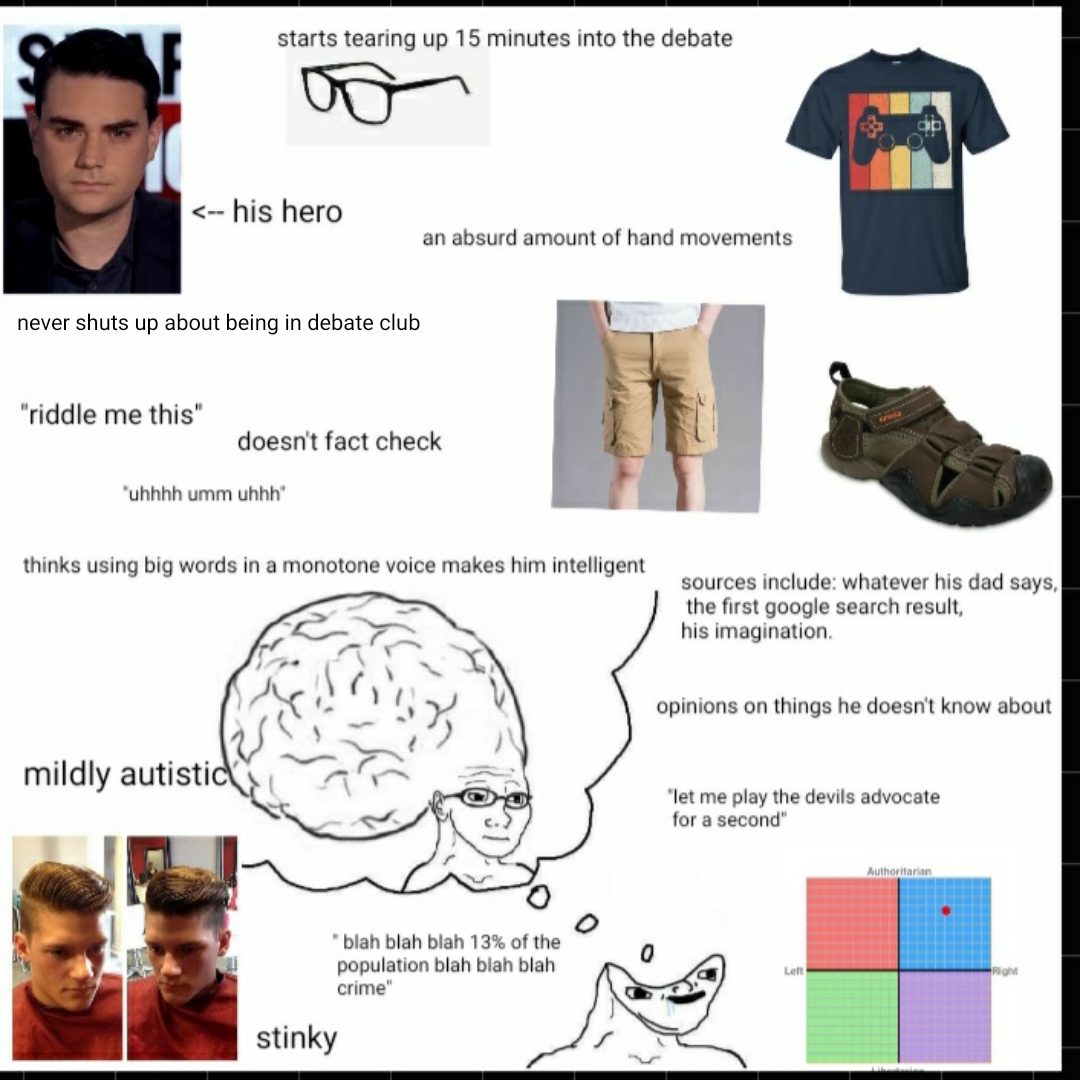
One of my greatest fears is being put on a livestream with one of these guys, the wannabe-Ben-Shapiro-debate-guy, not because he'll rip me to shreds with Facts and Logic, but because I'll be ripped to shreds in spite of the knowledge that his Facts and Logic are complete gibberish.
In spite! The knowledge that I could've prevented myself from being ripped to shreds, and failing to do so in spite, is far too galling.
The thing about this wannabe-Ben-Shapiro-debate-guy is that his best lines don't survive when written down. Such words defy belief when transcribed, unpersuasive and gibberish even, but when delivered in front of a roaring, delirious crowd, they're a certified checkmate for his opponent.
Aura loss! You just got owned! shout his faithful goons.
So how do we not get "owned"?
Even setting aside my fear of getting cornered by a Ben Shapiro wannabe, I'd like to be better at spoken conversation in general, with normal folk. Most normal folk are perfectly reasonable human beings who don't seek to destroy me with Facts and Logic, and even then, I speak as though I'm still drafting the sentence as it leaves my mouth.
In oral delivery, I feel like I'm doing this funky "backlooping" structure, rambling and repeating myself as I hone my argument on the go.

Backlooping - teach me how to do one of those, in spoken form!
I believe the best orators have a skill that I don't, which is that they can ramble and still sound like they're thinking clearly in real time.
I am not one of these people. Added to that fact, I confidently mispronounce half the Big Words that I'm otherwise comfortable typing, and I don't quite speak with an honest-to-god Standard American accent (even though I grew up here), and I suspect both of these things conspire to undercut whatever credibility my words might otherwise carry.
This simple goal of mine, of sounding coherent when I'm thinking on my feet, is at least learnable. I'm positive that, with enough practice, I'll deliver a perfect impression of the wannabe-Ben-Shapiro-debate-guy myself.
The Jess studies the natural orators
So, I got a little systematic about studying this species of human, the Ben-Shapiro-wannabe guy and his various cousins.
See, I have a couple of people in my life who've built up what I can only describe as an unusual superpower, where you can drop them into a conversation about something they have zero background in, and somehow they still end up contributing and steering the conversation in this wonderfully charismatic, disarming way.
I envy these people! I mean that fondly!
As someone who wants this superpower badly, I started watching these people closely for the moment a conversation turned to something they didn't know much about, and paying attention to what they did. How do they pull this off, to sound like they belong in the conversation, regardless of what they know?
The Jess has Theory
So, here we are, after swapping out some of my music playlists for podcasts and studying my unsuspecting friends irl, I'm ready to present my Theory.
I like to think of the conversation as a river, and the podcast host as somebody who's spent a lot of time around rivers in general. They don't need to know is what's in this particular river; they don't even know how to swim!
They just need to know how water moves and how the flow of the river can be derailed or blocked by debris, so that they can keep the current moving when something gets in the way.
Basically, they are experts in the shape of the conversation, agnostic of its contents.
Here are the basic moves, that don't require much content knowledge, just that you're good at paying attention to your guest:
- Naming and controlling the structure of the conversation
- Restating and asking the guest to elaborate
And the more advanced moves that require you actually know things about the subject of convo (though the expert Ben-Shapiro-wannabes seem to manage without it just fine):
- Introducing a complication
- Offering an outside parallel
Now let me talk over the moves themselves. In spite of how much fun I have making fun of some of these, I do think that about half of these will make you a more empathetic listener and a better conversation partner, provided that you don't use them irresponsibly.
Basic Move 1: Restating and asking the guest to elaborate
When I share these lines, I want to emphasize that it's less about the delivering the line itself and more about understanding the guest and building a picture of what's going on in their head.
As you listen to the guest speak, you should try to actively guess what they're thinking and what they'll say next, in real time, as the conversation moves. If you just throw these lines out mechanically, canned, disconnected from any educated guess about the guest, it comes across as flat and a little fake, and people can tell.
"I'm surprised you didn't say X"
This one I like a lot.
"Huh, this person expected me to say X?" is inherently interesting, because most people don't get direct feedback on how they're perceived all that often. I actually learned this line from having it used on me a couple of times, and I can remember every single time someone's said it to me, because it happens so rarely.
Anti-Manipulation Disclaimer
This only works if it's sincere. The guess has to be well-founded and genuinely thought through, don't say it unless you actually know enough about the person to make any sort of informed guess. If it's obviously fished for or generic, it reads as fake immediately! Please!
If you guess right, they're flattered that you understand them. If you guess wrong, it's still flattering, because now they get some of that rare, direct feedback on how they're perceived, and they get to correct you, and it gives them license to say something true and flattering about themselves ("actually it's not that, it's this...") without sounding like they're self-promoting out of nowhere.
Some people don't like small talk and really, really want people to talk about the big stuff, but the big stuff is HARD to answer off-the-bat. If you ask someone, "What's important to you?" out of the blue, that's hard to answer because they have nothing to work with.
And it's weird if, in the middle of a normal conversation, they announce, unprompted, "I think it's very important to pay it forward to kids who grew up like I did, and I'm grateful to my Uncle Bob for showing me that," it sounds like they're virtue signaling.
But if you say "I'm surprised you didn't say X", they can correct you and set the record straight. Now they have something to work off of, they can answer in contrast to X ("actually the opposite, it's about giving back") or on top of X ("well, sure, but really it's...").
Your wrong guess does the work of implicitly asking and then giving them a frame for a question that's otherwise difficult to answer.
"I would say you sounded skeptical/hesitant/almost gleeful of that..."
Sort of similar to the previous, except instead of cold-reading the guest's opinion, you're cold-reading their tone.
Literally repeating what the guest said
Suppose the guest, Dave, coins some distinctive phrase, like "vibes-based accounting." From here on, we'll call that a Dave-ism.
Later, you use it again yourself, "vibes-based accounting," folding Dave's own words back into one of your sentences, and everybody's happy because hey, this Dave-ism is pretty catchy, and Dave feels like his Dave-isms are catching on.
Basic Move 2: Naming and controlling the structure of the conversation
If Move 1 is about observing the guest, Move 2 is about controlling the pace and destination of the conversation.
"Before we go further, define that."
You know, for the rest of the room. You don't understand this thing that the guest is talking about, but remember, you're doing it for the benefit of everybody else who doesn't understand, either.
Bonus points if, after the guest explains it, you say:
- "...in what context?" No, no, you're not just asking them what this thing means. You're asking in what context! Wow, big brain!!
"Tell me more about what you just touched on quickly, which is..."
This is how you steer the conversation back to something good the guest mentioned in passing; it flatters them that you remembered it, and it gives you both a chance to slow down and give their good point some more air time.
Now, "tell me more" can be a scary open-ended question that's difficult to answer cold, in which you do the earlier move of actively modeling what the guest will say next and throwing your guess on the table for the guest to either affirm with a "yes, exactly" or correct you if you're off.
"Is what we want for X? Or is what we want for Y?"
You know how when you're in a meeting and it gets heated and then there's one guy that goes, "Guys, guys, guys, can we take a step back?"
The lot of you quiet down and turn around to look at the "let's take a step back" guy, and he says,
What problem are we really trying to solve?
Wow! You marvel at his intelligence for having asked this question.
Well, the line, "Okay, what do we reaaaaally want? Is it for X? Or is it for Y?" does something similar. Here, instead of playing the game, you are redefining the rules of the game, which is a cosmic level Big Brain Move. You don't even have to be a proficient participant of the game you're playing because your very point is that hey, let's redefine the rules of this game.
Bonus points if in your "Is it for X? Or is it for Y?", you...
- introduce some kind of inversion, like "Is it that we're moving too fast? Or is it that we're not moving fast enough?"
- insert an interjection of "...or what we SHOULD want?"
- Not just what we want, but what we SHOULD want, because, you know, there's a difference that makes you look very very smart.
- attempt a scope inflation, where you recast the previous convo topic as a smaller instance of a Much Bigger Question.
- "Is this really about the button color? Or is it about how we think about trust in the interface?"
- Now you feel a small wave of shame wash over you, because here you were, debating pixel values like a peasant, while this person has ascended to a higher plane where they contemplate Trust Itself.
- "Is this really about the button color? Or is it about how we think about trust in the interface?"
Putting the pieces together, you have a sentence like this:
"Is what we want, or what we should want, for China to be exporting less, for it to have less of an overcapacity, as it gets called? Or is what we want for China to be more open to imports?"
Wow! Massive brain. Just don't overdo it or else it can get a little insufferable.
One more important thing is that you need to know how to answer your own question, because it's entirely fair for someone to turn around and go "Okay, so what do you think it is, X or Y?" The honest thing to do is present your X or Y if you have thoughts on this.
And if you genuinely don't know, you answer their question with another question! Something like:
"Well, what would we observe if it were Y and not X?"
and it's great, because now you're all figuring it out together.
Advanced Move 1: Introducing a complication
Okay, now we're heading into the advanced moves, and I call them advanced because they require you to have some concrete knowledge of the conversation subject.
"If we assume X, what's the penalty?"
I also unironically like this question. It was a framework introduced by the staff of the Operating Systems course at CMU, as a way to get students to go from vague, scary questions like "I don't know. Should I do this? Can I assume this? Tell me what to do!" to useful questions that would help the staff help the student (or, more accurately, help the students help themselves).
Note you do NOT ask "Can we assume X?" When you ask whether we can assume something, you're opening the floor to litigate X itself, which can be hard to answer when neither of you actually knows whether X is true or why you want to assume it or not. You can go back and forth forever without new information!
Instead, you skip past that into the hypothetical world where X is already settled. Implicitly you've already made a vote for assuming X, and if after walking through the consequences together, you find that the penalty for assuming X is too high, then you remove the assumption.
Playing devil's advocate
So, uh, calling attention to the fact that you're playing devil's advocate is pretty obnoxious, because it carries an air of "brace yourself!" that can antagonize your guest.
If you're legitimately playing devil's advocate...
a situation where someone... takes a position they do not necessarily agree with for the sake of debate
...then you should stay neutral as promised, rather than antagonizing the guest into a game of right/wrong. The best way to do this is to play devil's advocate without patting yourself on the back too much, like:
- "Let me make the argument for X for a minute and see how you respond to that..."
Or more dramatically, the way Ezra Klein likes to say it:
- "Let me give voice to the discomfort I've heard from it on the other side..."
- ...and my question for you is, does it have strength in it?
Advanced Move 2: Offering an outside parallel
This one is a bit different, in that you don't need deep knowledge of the subject itself per se, but it requires you have deep knowledge of an adjacent or parallel subject that you can then draw analogies about.
The conversation might be about Y, but your expertise is in X, and the move is to bring X in as a lens for looking at Y.
So, you know a lot about X, and the conversation is about Y, and you want to draw a connection between the two to introduce your thesis about your pet-obsession X without sounding like it came from nowhere.
- "I've long been interested in X..."
- "I've long been fascinated by this question of
insert reframe of Y... and how it shows up in X."
How long is "long"? Who knows? Now, I think this wording is a little silly, because it makes you sound as though you've been plagued by this question since the moment you came out of the womb, wandering the earth in search of an answer, when really you probably just thought of it and drew the connection on the spot.
But all that matters is you've steered the conversation away from Y, which you don't know nearly as much about, and towards X, which is your home turf! Hooray!
Don't forget to hand the mic back to the guest to talk about Y, though, so that you're not ignorant forever and you actually learn something about Y.
"HISTORICALLY..."
Say the word "historically." Now say it again! How does it feel to roll off of your tongue?
There's something about the framing of a historical parallel that brings the, you know, you know, je ne sais quoi, and the, what's the word, yes that's the word, gravitas.
My pet peeve with this, though, is that it is equally abused to turn people's personal opinions into unfalsifiable appeals to authority, sort of like when people say "it's scientifically proven..." or "studies show..." and then never name the study.
I much prefer this move when you can actually name the specific event it parallels; "historically" is a much stronger word when it's followed by a real case and timeframe rather than left to float there.
Jess, you analyzed all this stuff and yet you're still bad at it
Yes! Everything above is Theory. I can watch someone make the move in real time and immediately know that that's exactly what they're doing, all without making my own mouth do it in the moment I need it.
The gap between people who know and people who sound like they know, is, in fact, kind of the whole subject of this essay.